Lowland Bongo:

7:43 AM
Lowland Bongo:

The western or lowland bongo, Tragelaphus eurycerus eurycerus, is a herbivorous, mostly nocturnal forest ungulate and among the largest of the African forest antelope species. Bongos are characterised by a striking reddish-brown coat, black and white markings, white-yellow stripes and long slightly spiralled horns. Indeed, bongos are the only Tragelaphid in which both sexes have horns. Bongos have a complex social interaction and are found in African dense forest mosaics. The lowland bongo faces an ongoing population decline and the IUCN Antelope Specialist Group considers the western or lowland bongo, T. eurycerus eurycerus, to be Near Threatened on the conservation status scale. The eastern or mountain bongo, T. eurycerus isaaci, of Kenya has a coat even more vibrant than that of T. eurycerus eurycerus. The mountain bongo is only found in the wild in one remote region of central Kenya. The mountain bongo is classified by the IUCN Antelope Specialist Group as Critically Endangered with more specimens in captivity than in the wild.

Source:
Pic | Link:
Wikipedia | Link:

The Siberian Husky:

7:37 AM
The Siberian Husky:

The Siberian Husky  is a medium-size, dense-coat working dog breed that originated in north-eastern Siberia. The breed belongs to the Spitz genetic family. It is recognizable by its thickly furred double coat, sickle tail, erect triangular ears, and distinctive markings. Huskies are an active, energetic, and resilient breed whose ancestors came from the extremely cold and harsh environment of the Siberian Arctic. Siberian Huskies were bred by the Chukchi of Northeastern Asia to pull heavy loads long distances through difficult conditions. The dogs were imported into Alaska during the Nome Gold Rush and later spread into the United States and Canada. They were initially sent to Alaska and Canada as sled dogs but rapidly acquired the status of family pets and show dogs. Because of their efficiency as a working breed, most huskies are bred to be able to withstand long work days on little amounts of food. They can travel up to 40 miles per day.

Source:
Pic | Link:
Wikipedia | Link:

The Victoria Crowned Pigeon:

7:29 AM


The Victoria Crowned Pigeon:

The Victoria Crowned Pigeon (Goura victoria) is a large, bluish-grey pigeon with elegant blue lace-like crests, maroon breast and red iris. It is part of a genus of three unique very large, ground-dwelling pigeons native to the New Guinea region. The bird may be easily recognized by the unique white tips on its crests and by its deep 'whooping' sounds made while calling. Its name commemorates the British monarch, Queen Victoria of the United Kingdom.

Source:
Pic | Link:
Wikipedia | Link:

The Icelandic horse

3:10 AM

The Icelandic horse

The Icelandic horse is a breed of horse developed in Iceland. Although the horses are small, at times pony-sized, most registries for the Icelandic refer to it as a horse. Icelandic horses are long-lived and hardy. In their native country they have few diseases; Icelandic law prevents horses from being imported into the country and exported animals are not allowed to return. The Icelandic displays two gaits in addition to the typical walk, trot, and canter/gallop commonly displayed by other breeds. The only breed of horse in Iceland, they are also popular internationally, and sizable populations exist in Europe and North America. The breed is still used for traditional farm work in its native country, as well as for leisure, showing, and racing

Source:
Pic | Link:
Wikipedia | Link:

The Yellow-footed Green Pigeon..

3:02 AM
The Yellow-footed Green Pigeon

The Yellow-footed Green Pigeon (Treron phoenicoptera), also known as Yellow-legged Green Pigeon, is a common species of green pigeon found in the Indian Subcontinent. It is the state bird of Maharashtra.[1][2] In Marathi it is called Hariyal. The species feeds on fruit, including many species of Ficus. They forage in flocks. In the early morning they are often seen sunning on the tops of emergent trees in dense forest areas.

Source:
Pic | Link:
Wikipedia | Link:


lynx...

2:58 AM
lynx...

A lynx  is any of the four species within the Lynx genus of medium-sized wildcats. The name "lynx" originated in Middle English via Latin from the Greek word "λύγξ" derived from the Indo-European root "*leuk-", meaning "light, brightness",[4] in reference to the luminescence of its reflective eyes.[4] There is considerable confusion about the best way to classify felids at present, and some authorities[who?] classify them as part of the genus Felis. Neither the caracal, sometimes called the Persian lynx or African lynx, nor the jungle cat, called the swamp lynx, is a member of the Lynx genus

Source:
Pic | Link:
Wikipedia | Link:

The Resplendent Quetzal...

2:47 AM
The Resplendent Quetzal...

The Resplendent Quetzal (Pharomachrus mocinno) is a bird in the trogon family. It is found from southern Mexico to western Panama (unlike the other quetzals of the genus Pharomachrus, which are found in South America and eastern Panama). It is well known for its colorful plumage. There are two subspecies, P. m. mocinno and P. m. costaricensis. This quetzal plays an important role in Mesoamerican mythologies. The Resplendent Quetzal is Guatemala's national bird, and an image of it is on the flag and coat of arms of Guatemala. It is also the name of the local currency (abbreviation GTQ).

Source:
Pic | Link:
Wikipedia | Link:

Tree-kangaroos:

2:42 AM

Tree-kangaroos:


Tree-kangaroos are macropods adapted for life in trees. They inhabit the rainforests of Australia and New Guinea, far northeastern Queensland, and nearby islands. Although most are found in mountainous areas, several species also occur in lowlands, such as the aptly named Lowlands Tree-kangaroo. Most tree-kangaroos are considered threatened due to hunting and habitat loss. There are 14 species of tree-kangaroos, though some uncertainty exists due to taxonomy. Depending on species, there are significant variations in the color of the pelage and size, with a head and body length of 41 to 77 centimetres (16 to 30 in), a tail length of 40 to 87 centimetres (16 to 34 in), and a weight of up to 14.5 kilograms (32 lb). Females are smaller than males.

Source:
Pic | Link:
Wikipedia | Link:

The Violet Sabrewing:

6:58 AM

The Violet Sabrewing

The Violet Sabrewing (Campylopterus hemileucurus) is a very large hummingbird native to southern Mexico and Central America as far south as Costa Rica and western Panama. It is a species of the understory and edges of mountain forests, especially near streams. The female Violet Sabrewing lays its two white eggs in a relatively large cup nest on a low horizontal branch, usually over a stream. The Violet Sabrewing is 15 cm long; the male weighs 11.5 g and the female 9.5 g. It is the largest hummingbird found outside of South America and the largest sabrewing. The adult male is deep violet, with a dark green back and wing coverts. The shafts of the male’s outer primary flight feathers are thickened and flattened to give the distinctive feature which gives the sabrewings their English and scientific names. The three outer pairs of feathers of the otherwise black tail are white; this gives rise to the scientific species name, hemileucurus translating as "half-white tail", but several other sabrewings share the tail pattern, not least the White-tailed Sabrewing of Venezuela and Tobago.

Source:
Picture | Link:
Wikipedia | Link:

The Harpy Eagle (Harpia harpyja):

6:56 AM
The Harpy Eagle (Harpia harpyja):


The Harpy Eagle (Harpia harpyja) is a Neotropical species of eagle. It is sometimes known as the American Harpy Eagle to distinguish it from the Papuan Eagle which is sometimes known as the New Guinea Harpy Eagle or Papuan Harpy Eagle. It is the largest and most powerful raptor found in the Americas,[4] and among the largest extant species of eagles in the world. It usually inhabits tropical lowland rainforests in the upper (emergent) canopy layer. Destruction of its natural habitat has seen it vanish from many parts of its former range, and it is nearly extirpated in Central America. In Brazil, the Harpy Eagle is known as Royal-Hawk (In Portuguese: Gavião-Real)

Source:
Picture | Link:

wikipedia | Link:

The Glasswinged butterfly:

6:49 AM
The Glasswinged butterfly:

The Glasswinged butterfly (Greta oto) is a brush-footed butterfly, and is a member of the subfamily Danainae, tribe Ithomiini, subtribe Godyridina.G. oto adults also exhibit a number of interesting behaviors, such as long migrations and lekking among males.

Source:
Pic | Link:
Wikipedia | 

Pallas's cat:

6:44 AM
Pallas's cat:


Pallas's cat (Otocolobus manul), also called the manul, is a small wild cat having a broad but patchy distribution in the grasslands and montane steppe of Central Asia. The species is negatively affected by habitat degradation, prey base decline, and hunting, and has therefore been classified as Near Threatened by IUCN since 2002. Pallas’s cat was named after the German naturalist Peter Simon Pallas, who first described the species in 1776 under the binomial Felis manul.

Source:
Picture | Link:

Golden monkey...

1:49 AM

Golden monkey

The golden monkey  is a species of Old World monkey found in the Virunga volcanic mountains of Central Africa, including four national parks: Mgahinga, in south-west Uganda; Volcanoes, in north-west Rwanda; and Virunga and Kahuzi-Biéga, in the eastern Democratic Republic of Congo. It is restricted to highland forest, especially near bamboo. This species was previously thought to be a subspecies of the blue monkey (Cercopithecus mitis),[1] and the two are similar overall, but the Golden Monkey has a golden-orange patch on the upper flanks and back. Not much is known about the golden monkey's behaviour. It lives in social groups of up to 30 individuals. Its diet consists mainly of leaves and fruit, though it is also thought to eat insects.

Source:
Pic | Link:
Wikipedia |  Link:

Black-naped Monarch...

10:13 PM

Black-naped Monarch...

The Black-naped Monarch or Black-naped Blue Flycatcher (Hypothymis azurea) is a slim and agile passerine bird belonging to the family of monarch flycatchers. They are sexually dimorphic with males having a distinctive black patch on the back of the head and a narrow black half collar ("necklace") while the female is duller and lacks the black markings. They have a call that is similar to that of the Asian Paradise Flycatcher and in tropical forest habitats pairs may join mixed-species foraging flocks. Populations differ slightly in plumage colour and sizes.

Source:
Pic | Link:
Wikipedia | Link:

Antelope...

10:08 PM

Antelope


Antelope is a term referring to many even-toed ungulate species indigenous to various regions in Africa and Eurasia. Antelopes comprise a miscellaneous group within the family Bovidae, encompassing those old world species that are neither cattle, sheep, buffalo, bison, nor goats. A group of antelope is called a herd.

Source:
Pic | Link:
Wikipedia | Link:

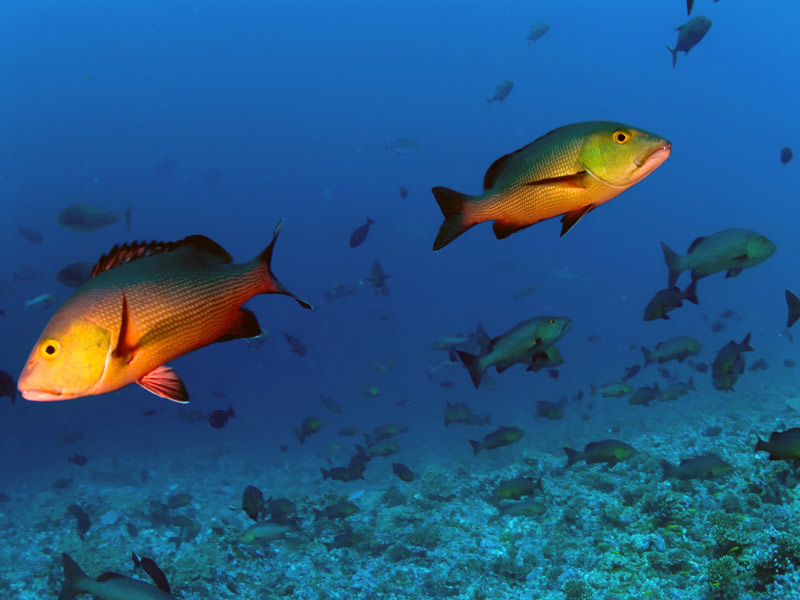
Lutjanidae...

6:08 AM
Lutjanidae...

Snappers are a family of perciform fish, Lutjanidae, mainly marine, but with some members inhabiting estuaries, feeding in freshwater. Some are important food fish. One of the best known is the red snapper. Snappers inhabit tropical and subtropical regions of all oceans. They can grow to about 1 m (3.3 ft) in length. Most feed on crustaceans or other fish, though a few are plankton-feeders. They can be kept in aquaria, but mostly grow too fast to be popular aquarium fish. They live at depths reaching 450 m (1,480 ft). About 100 species are currently recognized, divided into about 16 genera. A large number of species have "snapper" in their common names; most but not all are Lutjanidae. Nearly all of the 60 or so species in genus Lutjanus have common names that include the word "snapper".


Source:
Pic | Link:
Wikipedia | Link:

Siamese fighting fish

6:01 AM

Siamese fighting fish

The Siamese fighting fish also known as betta, is a popular species of freshwater aquarium fish. The name of the genus is derived from ikan bettah, taken from a local dialect of Malay.[1] The wild ancestors of this fish are native to the rice paddies of Thailand, Malaysia, Cambodia and Vietnam and are called pla-kad (lit. biting fish) in Thai or trey krem in Khmer.

Source:
Pic | Link:
Wikipedia | Link:

About Us

Recent

Random